

Table of Contents
Mastering Candle Range Theory
Most traders analyze market structure using swing highs and lows across multiple candles. But what if a single candle could reveal everything you need for a high-probability trade?
That’s the core insight behind Candle Range Theory (CRT)—a precision trading framework that treats every individual candle as its own isolated range with built-in liquidity targets. When combined with smart money concepts, this approach transforms simple price action into consistent, structured trade opportunities.
What Makes Candle Range Theory Different?
Traditional technical analysis focuses on multi-candle patterns and broader market structure. CRT flips this approach by zooming into the micro-structure of individual candles.
Consider a daily candle on your chart. When you drop down to the 1-hour timeframe, that single daily candle’s wicks represent the 1-hour swing high and swing low—forming a complete, self-contained range. This isn’t just theoretical. Look at any chart and you’ll notice that nearly every candle attacks either the previous candle’s high or low. CRT simply gives us a systematic framework to anticipate and trade these movements.
The key principle: when price attacks one side of a candle’s range but fails to close beyond it, there’s a high probability it will target the opposite side next.
The Three-Candle Framework: Your Foundation
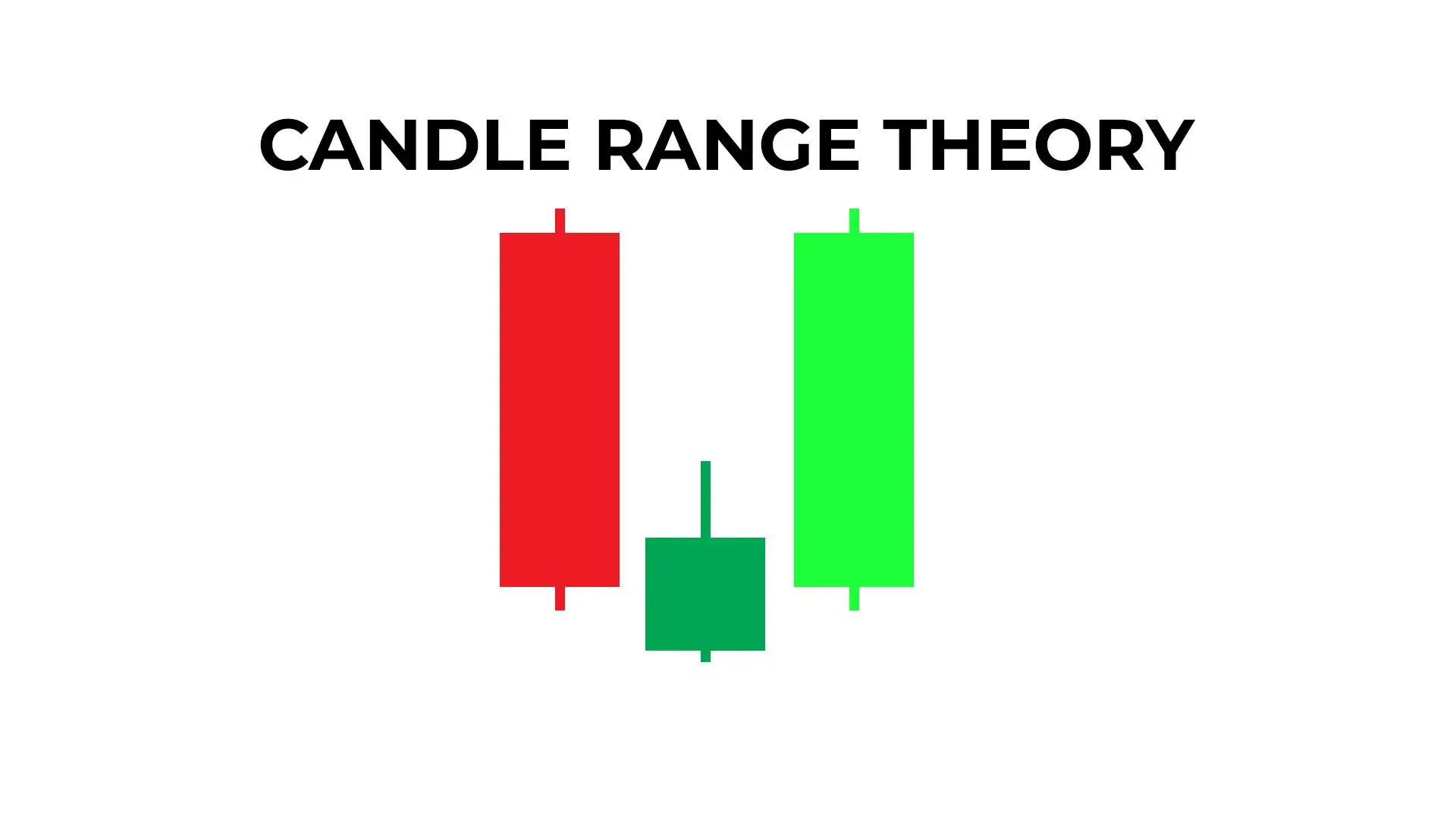
CRT typically operates on a three-candle setup, though we’ll explore variations later. Each candle plays a specific role:
Candle 1: Define Your Range
The first candle establishes your trading zone. This can be any candle on any timeframe, though certain characteristics make a candle more tradable (we’ll cover selection criteria shortly).
From this candle, identify two critical levels:
- Candle Range High (CRH): The top wick—your upper liquidity target
- Candle Range Low (CRL): The bottom wick—your lower liquidity target
These wicks act as isolated liquidity pools that subsequent price action will gravitate toward.
Candle 2: The Setup Validator
This is your make-or-break candle. The entire CRT concept hinges on what happens here.
For a bearish setup, you need to see:
- Price pushes above the Candle Range High
- Price then pulls back into the range
- The candle closes within the range (not above the CRH)
This creates a liquidity sweep—a false breakout that traps buyers and signals the next target will likely be the Candle Range Low.
If the second candle closes above the CRH instead, the setup is invalid. The market has confirmed bullish momentum, and you should expect continuation upward rather than reversal.
Candle 3: Entry Execution
Once your setup is validated, the third candle is where you execute. Your target: the Candle Range Low of the first candle.
Rather than taking a risky breakout entry at the second candle’s low, wait for price to develop internal structure that offers a better risk-to-reward ratio—typically a bearish fair value gap (FVG) formed during the bearish leg.
Of course, you can hold beyond the CRL if broader market structure supports extended targets, but reaching the CRL completes the basic CRT setup.
The bullish variant follows identical logic in reverse: manipulation on a bearish candle’s range low, with targets at its range high.
Time Frame Alignment: The Professional Edge
Here’s where most beginners falter: they try to analyze and execute on the same timeframe.
The correct approach separates these functions:
- Higher timeframe: Define your candle range (CRH and CRL)
- Lower timeframe: Identify market structure and entry opportunities
This alignment gives you the strategic view of the higher timeframe while allowing precision entries on the lower timeframe.
Recommended Timeframe Pairings:
- Monthly candle → Analyze on Daily
- Weekly candle → Analyze on 4-Hour
- Daily candle → Analyze on 1-Hour
- 4-Hour candle → Analyze on 15-Minute
- 1-Hour candle → Analyze on 5-Minute
For example, if you identify a promising daily candle for CRT, drop down to the 1-hour chart to watch for the AMD structure (more on this next) and locate your actual entry trigger.
Beyond Three Candles: The AMD Model
While the three-candle framework is the clearest teaching example, real market structure doesn’t always cooperate with neat timeframes. A CRT setup might take two candles or six candles to complete.
What matters isn’t the candle count—it’s whether the price action displays a clear AMD formation:
A – Accumulation: Consolidation phase where price isn’t making significant directional moves
M – Manipulation: The liquidity sweep—price attacks the range high (or low) but fails to sustain, closing back within the range
D – Distribution: The directional move that targets the opposite side of the range
This three-phase model aligns with the “Power of Three” smart money concept. Your entry comes during the distribution phase, but only after accumulation and manipulation have been confirmed.
Example: Five-Candle Setup
Imagine your first candle defines the range. The next three candles consolidate with minimal directional bias (accumulation). The fifth candle sweeps the high but closes back in range (manipulation). The following candles then drive toward the range low (distribution).
Same setup, different timeframe expression.
Example: Two-Candle Setup
Sometimes the second candle alone contains the entire AMD structure—but you’ll only see it by dropping to a lower timeframe. On that lower view, you’ll find accumulation, manipulation via liquidity sweep, and distribution toward the range low, all within what appears as a single candle on the higher timeframe.
Time is relative. What matters is confirming the correct market structure, regardless of how many candles it takes.
Premium and Discount Zones: Optimize Your Risk-Reward
Not all entries within a CRT setup are created equal. Think of your candle range like any other trading range—you want to enter trades from optimal zones.
For bearish setups (using a bullish first candle):
- Target entries in the premium area—anywhere above the 50% midpoint of the range
- This maximizes your downside potential toward the CRL
For bullish setups (using a bearish first candle):
- Target entries in the discount area—anywhere below the 50% midpoint
- This positions you optimally for upside toward the CRH
A fair value gap that forms in the premium area during your bearish setup offers both structural confirmation and optimal entry pricing. You’re not just following the strategy—you’re executing it with precision risk management.
When to Use CRT (And When Not To)
CRT is powerful, but context is everything. A textbook CRT setup can fail spectacularly if it contradicts broader market structure.
Don’t Use CRT When:
External structure contradicts your setup. Imagine you identify a bearish CRT setup, but to reach the target CRL, price would need to break through a strong bullish fair value gap or order block just below. The external structure suggests buying pressure will overwhelm your bearish setup. In this scenario, skip the trade or even consider the opposite direction.
Always assess the bigger picture before committing to any CRT trade.
Ideal Scenarios for CRT:
1. Liquidity Attack Points
CRT excels when price reaches a key liquidity level. Is this a liquidity run (continuation) or a liquidity sweep (reversal)? CRT helps you answer this question in real-time by analyzing whether the candle at that level sweeps the range and reverses or breaks through and continues.
2. PD Array Confirmations
When price approaches a price delivery array—like a fair value gap or order block—you’re already anticipating a potential reversal. Use CRT to confirm whether that zone is being respected. If the candle at the PD array creates a sweep and reversal structure, you’ve got confluence between multiple smart money concepts.
3. Change of Character Follow-Through
After a change of character (CHoCH) signals a potential shift in momentum, CRT can validate whether that shift has staying power or is just temporary noise.
Putting It All Together: A Practical Workflow
Here’s how to implement CRT systematically:
Step 1: Identify a candle on your analysis timeframe that sits at a point of interest (liquidity level, PD array, structural pivot)
Step 2: Mark the Candle Range High and Candle Range Low
Step 3: Watch the next candle(s) for manipulation—a sweep of one side followed by a close back in range
Step 4: Drop to your execution timeframe and look for AMD structure confirmation
Step 5: Identify a high-probability entry point (typically a fair value gap) in the premium/discount zone appropriate to your trade direction
Step 6: Execute with your target at the opposite range boundary, adjusting if external structure supports extended targets
Step 7: Validate that external market structure supports (or at least doesn’t contradict) your trade thesis
The Bottom Line
Candle Range Theory isn’t about predicting the future—it’s about reading what the market is already telling you through the micro-structure of individual candles. Each candle creates its own battlefield between buyers and sellers, and the wicks mark where liquidity sits waiting to be targeted.
By systematically identifying when one side of that range has been swept but rejected, you position yourself to trade the high-probability move toward the opposite side. Combine this with time frame alignment, smart entry zones, and awareness of broader structure, and you have a repeatable, logical framework for consistent trading opportunities.
The key is patience and context. Not every candle offers a tradable CRT setup, and not every liquidity sweep leads to reversal. But when all the pieces align—AMD structure, external confluence, optimal entry zones—CRT becomes one of the most reliable tools in a smart money trader’s arsenal.
Start by observing CRT setups in hindsight on your charts. Identify the three candles, the AMD phases, and how price ultimately behaved. Once you can consistently spot completed setups, begin forward-testing with small size or paper trading. Mastery comes from repetition and refinement, not from rushing into live trades.
The market always leaves clues. Candle Range Theory simply teaches you how to read them.
